Blog Archives

Manda Makes a Game Part 6: Audio Adventures
Once I had locked in my flow, my script, and my puzzles, I was finally ready…to record.
Oh boy.
Oh boy oh boy oh boy. This ended up being…quite the process. Get ready for mostly GIFs…because, WordPress won’t let me upload videos of the tape recordings.
Recording was the thing that was on my mind all throughout the process but that I had no clue how it would truly go until I actually did it.
Read the rest of this entry
Manda Makes A Game Part 3: Narrative Considerations and Influences
To understand the rest of the design process for this game, I’m going to have to actually talk about the narrative first. Because it’s me. At the same time though…this is one of the more difficult things to talk about process wise. So..SPOILERS, if you ever actually want to play the game (likely not) and for my Secret Santa.


Manda Makes a Game Part 2: Spreadsheets, Scripts, and Flow
Am I procrastinating actually writing the game by writing about the process of writing a game?
Maybe.
While I am writing this blog series in real time, I am not releasing them until my game is safely shipped to avoid spoilers to my Secret Santa. I’m also writing these kind of piecemeal so while it looks like I had a very organized process where I went from one phase to the next with ease…that’s not really true. Things followed a general timeline, but there were lovely chaotic bits where I was brainstorming, writing, and gathering materials at the same time. But I figured splitting up blog posts by topic is far easier than bringing you 100% along my chaotic journey of madness. This time around, let’s focus on general organization!

An Escape Enthusiast Abroad: Netherlands Day 5
I am sitting in the airport writing this and feeling more than a little sad that our escape adventure is over for the time being, but at the same time sooooo happy that it got to happen!
Our final day also had a single escape room. Mondays are usually dark days for escape rooms, but Escape Room Junkie was very gracious when we were booking rooms back in May and were willing to have us book their game, Corpse Inc., with them on a Monday! We were very grateful.
Read the rest of this entry
An Escape Enthusiast Abroad: Netherlands Day 4
My feet are very sore. Many parts of my body feel bruised. But I had a very fun day. Just one escape today: Dark Park’s Stay in the Dark!
Read the rest of this entry
An Escape Enthusiast Abroad: Netherlands Day 3
Ohhhh my goodness. We did not get back to our hotel until 1am. I don’t think I have fallen asleep so fast in a long time.
Today I woke up far more refreshed. Which is a good thing because there was some trekking to be done today.
Read the rest of this entry
An Enthusiast Abroad: Netherlands Day 2 (Amsterdam)
You know, I didn’t bring my laptop with me because it would be too cumbersome. But now, I remember how much I hate typing on my phone. It takes so much longer!
Read the rest of this entry
An Escape Enthusiast Abroad: Netherlands 2 Electric Boogaloo- Day 1
I am back! And abroad! Yes, after a long period of withdrawal I am back on an escape room trip. Not only is it another escape room trip, but a return to the Netherlands no less!
This time around I am with my regular crew: Errol, his sister Lizette, our friend Margaux and special guest Myra, who we met during the pandemic and became a regular part of our online escape crew! It is great meeting her in person! The whole trip started because Lizette was going to be hanging around Europe for 2 weeks, so we figured, why not plan escapes around it?
Read the rest of this entryEnigMarch Day 19
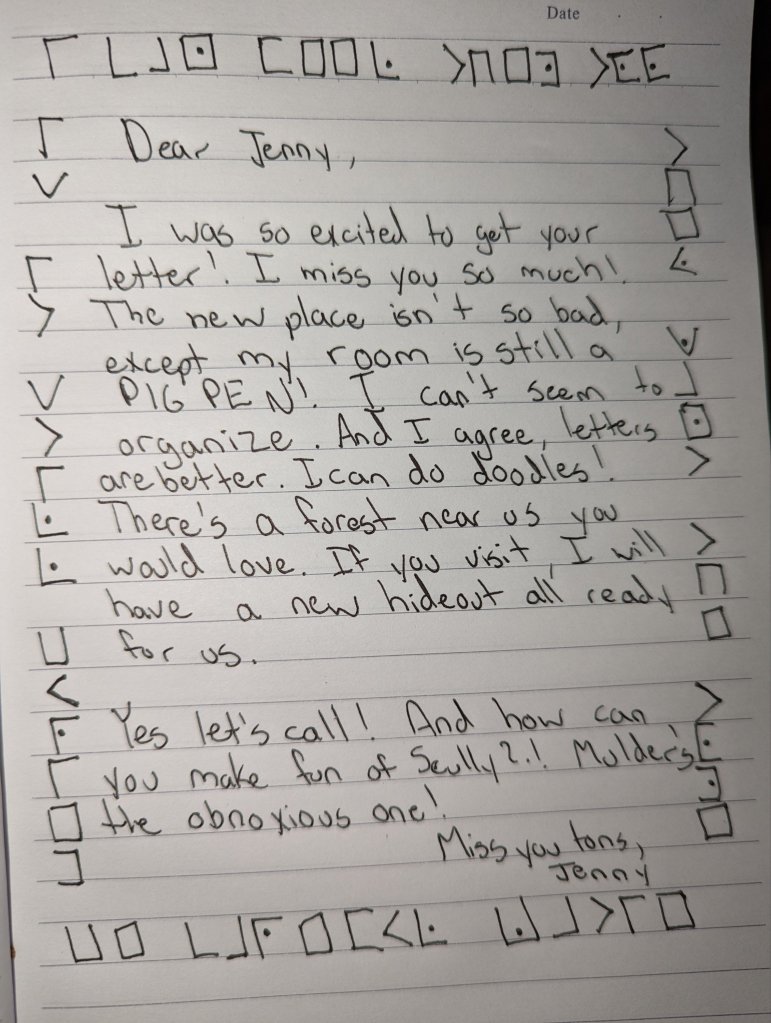
Here is my EnigMarch attempt for Day 19!! This time I handwrote it out. You can see the explanation and my first attempt at EnigMarch here.
I am finding I am enjoying the challenge of fitting in a cipher into the content of a letter, and the different ways it can be done. Where am I going with the narrative? Not sure yet! But I am liking the process.

Escape Room Narrative: The Power of Post-its
Post-its…are amazing.

No, really. I adore them. Unfortunately, it’s not because I am incredibly adept at using them to organize my life. It’s because they can be a very powerful narrative tool. Over the last couple of years, I have really come to appreciate the story telling power of that little yellow square. In fact, in my most recent project, I have begun to use them as a way to shorten what are otherwise lengthy passages of text.
I will admit. I am someone who struggles with…efficiency in her writing. This blog is proof of concept for that idea. There I will be, trying to write a journal passage at 200 words max and suddenly it’s 1,000. I recently submitted a magazine article where the editor told me not to worry, I had PLENTY of words at 1,250. I hit the limit halfway through my article.
Then it occurred to me. What if I took those long, meandering journal entries, and tried to distill their essence onto a single post-it. Would I be able to get the same information across limited to a few words?
It’s not like it’s a new idea. Years ago the game Gone Home (and yes, it’s old now, but it set the bar for so much environmental storytelling) introduced the concept to me. In the game you find a book with a single post-it note on it.
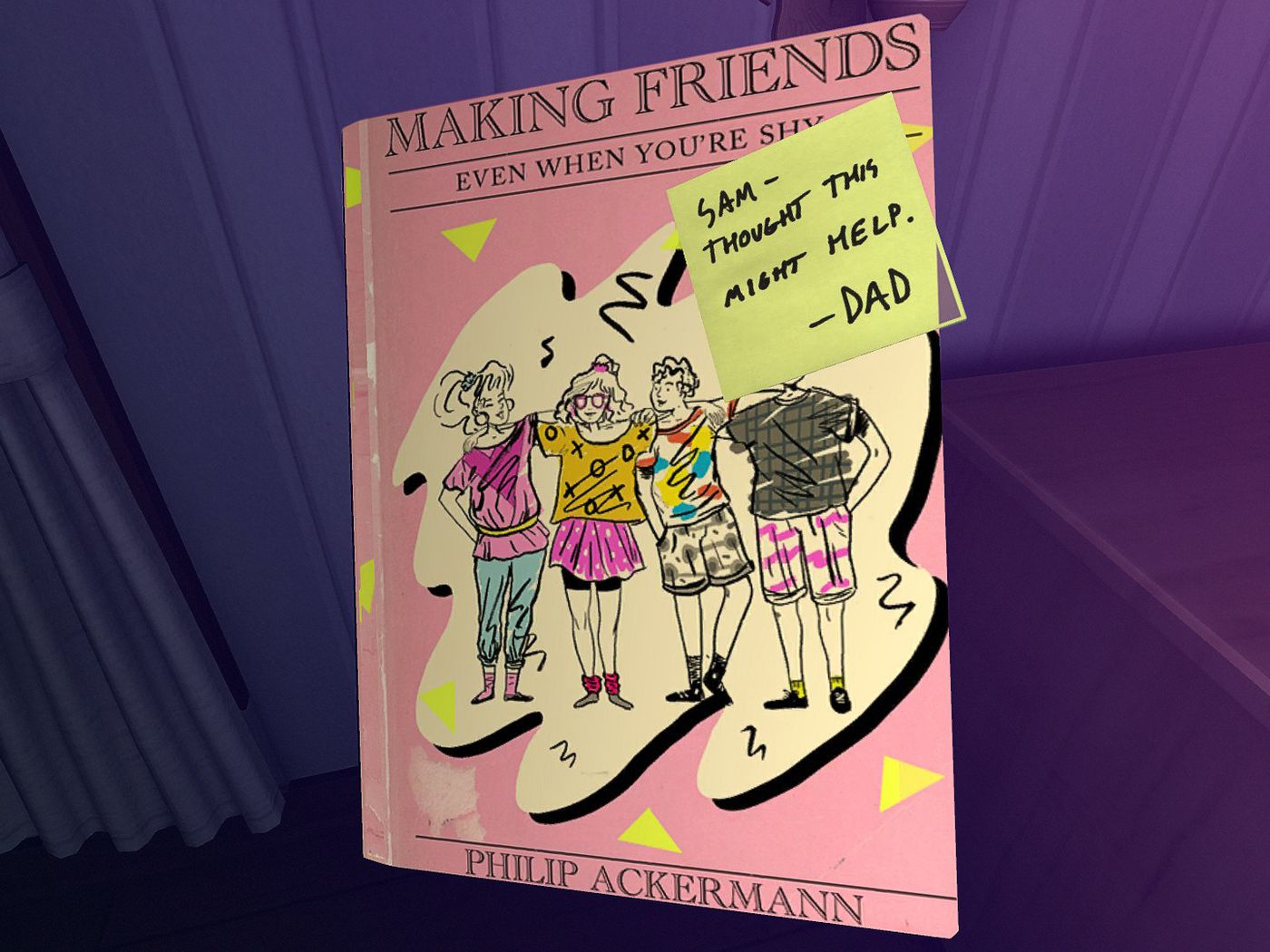
Now, the post-it note works in conjunction with the book. The book tells us our main character might struggle with making friends. The post-it tells us everything we need to know about who wrote this and what the state of their relationship is. From the post-it we learn Sam’s dad bought her a book. We can infer that her dad cares about her very much but has a tough time relating. Note that it doesn’t say “Love, Dad”. He obviously has trouble actually talking things through with his daughter. He would rather leave the book on a table with an explanatory note than actually talk through his daughter’s struggles face to face. But the fact that he did anything indicates he does care very much.
All of this from a book and a single post-it.
Now let’s shift to escape rooms. Let’s pretend we have a teenage character here as well. You approach a locked door. Earlier, you found a diary, a natural thing for a teenage girl to have. Inside, you find an entry:
Ugh. Dad is so annoying. He keeps barging into my room without my permission! Doesn’t he have ANY boundaries? It’s SOOOO embarrassing to be on a video call with my friends and have them watch him barge into the room and ask about my laundry. My LAUNDRY, for crap’s sake! He even brought up me getting taco sauce on my shirt! I bet everyone thinks I’m some slob now! Ugh! I don’t even know what to do. If he just knocked, it wouldn’t be so bad. It’s just common decency to ask permission before you enter someone’s private space!

The entry itself is not that long, but it’s a lot of details to parse through and, as with a lot of journals in escape rooms, it’s often only one person reading it. You can’t guarantee what details they are going to pick up on. Are they going to focus on the taco sauce? The laundry? Will they pick up the fact that this girl just wants her dad to knock? Maybe. Maybe not.
What if instead of writing a description in a journal, there was a single post-it on the door instead. All it contains are the words “Sarah’s room. Knock first! (that means you, Dad!!!)”

What does this get across? We have a character name: Sarah. We have a relationship: she obviously has a somewhat antagonistic relationship with her father. We have a tone: Sarah is annoyed. Most importantly, it gives an action: knock. Because the post-it is right on the door, most players should be able to see it.
This brings us up the “Need to know”, “Nice to know”, “Superfluous” rules of narrative design for games. What do the players need to know? They need to know to knock to progress the game. They know the owner of this bedroom is named Sarah, which might be important later.
What is nice to know? Sarah lives with her father and is annoyed at him. It’s not necessary for the story to progress, but it does add important character information to the narrative and can enhance the experience.
What is superfluous? I left out information on the Zoom call, the laundry talks, the taco sauce, and her embarrassment. The embarrassment should be evident in the tone. The rest of it is great for designers needing to flesh out a world, but serves absolutely no purpose but to reinforce what the players already know. And in a timed environment like an escape room, efficiency in narrative is key.

At this point, the players might knock on the door having been hinted by the post-it, and the door will open automatically. In my dream world, this is a haunted house game and it’s the ghost opening the door. But it could be used in other contexts as well.
How about another example?
Let’s say you are in a bank. There is a thick manual on what to do in case you forget your password. The process is long and involved, and it’s not entirely clear what section of the manual you need to go to. Perhaps though you find a post-it on the front of the manual: “Jay! Forgot your password AGAIN?! Just go to page 50. You’re lucky I love you. Jack.”
Now we’ve added a bit more flavour to what would otherwise be a tedious searching task. We now know immediately where to go and get a sense of what these two characters mean to each other.
This is not to say that post-its have to be littering your room. But it’s a good exercise to do yourself. It might help you figure out how much of the reading your players have to do could be cut down, or even how much of an audio monologue is actually superfluous information.
There are things to consider when writing your post-it narratives: who is the post-it from? Who is it being written to? What is the purpose? What does the sender want the receiver to know? How do they feel about what they are saying? Exclamation points can get across just as much emotion as a five-minute monologue.
Look at your narrative. Look at all of your narrative devices (books, journals, screens of text, audio monologues, etc) and give yourself a challenge: can you fit your story beats onto a post-it? How much can you still get across without having more than handful of words? You might surprise yourself on how little of the story you lose.


 Thoughts from the Test Chamber